
What chemical reactions occur between wet alkaline concrete and shuttering adhesives under 45°C+ Middle Eastern desert temperatures?
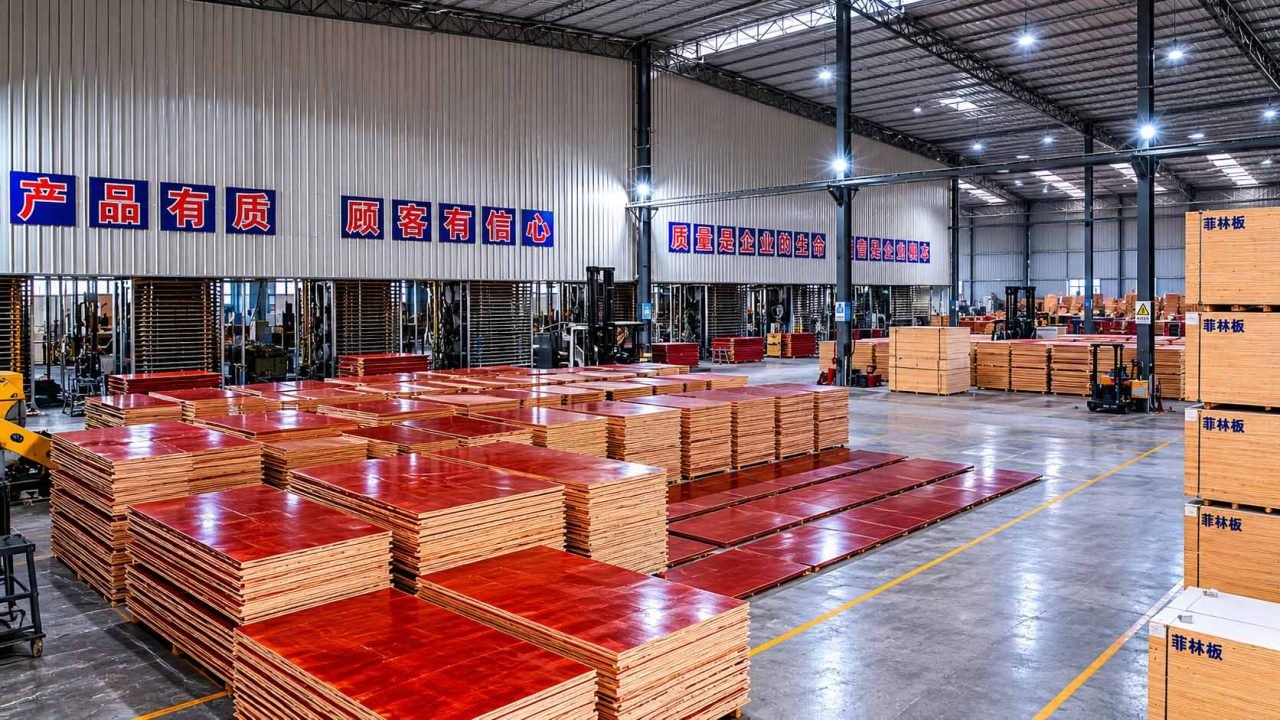
Q1:What chemical reactions occur between wet alkaline concrete and shuttering adhesives under 45°C+ Middle Eastern desert temperatures?
Fresh concrete paste is a harsh chemical environment with a pH between 12.5 and 13.5, driven by calcium hydroxide ($\text{Ca(OH)}_2$) generated during cement hydration. In high-temperature conditions common across Saudi Arabia, Qatar, and the UAE—where surface temperatures on metal and wood formwork frequently exceed 50°C—chemical degradation accelerates:
-
Alkaline Hydrolysis (Saponification): Standard ester-based adhesives and poorly formulated urea resins undergo alkaline hydrolysis. Hydroxide ions ($\text{OH}^-$) attack the polymer backbone, breaking cross-linked chains and turning adhesive bonds into soft, non-cohesive compounds.
-
Moisture Differential Stress: Extreme ambient evaporation pulls water out of the inner plies toward the exposed edges, while the face panel absorbs alkaline slurry water. This creates high shear stress across the glue line, resulting in edge ungluing and veneer splitting.
Q2: Why does a fully cured phenolic surface film prevent panel saponification and surface dusting?
Phenolic formaldehyde resins form a tightly cross-linked three-dimensional polymer network during high-temperature thermal pressing ($>135^\circ\text{C}$).
Protective Mechanisms of Phenolic Overlays
-
Chemical Inertness: Fully cured phenolic resin resists saponification from calcium hydroxide solutions, creating an impermeable barrier between wet concrete and internal wood plies.
-
Controlled Water Retention: The dense film prevents the dry wooden core from rapidly absorbing hydration water out of the fresh concrete surface. This allows concrete along the formwork face to cure evenly, eliminating dusting, scaling, and cosmetic discoloration.
-
Extended Multi-Pour Integrity: High-solid phenolic surface coatings allow panels—such as standard 12mm red boards (rated for 6–8 reuses) and heavy-duty 18mm phenolic panels (rated for 15–20 reuses) produced by NQ Formwork Plywood Co., Ltd.—to strip cleanly pour after pour without degrading the underlying core.
To review daily thermal-press monitoring and laboratory boiling immersion procedures, browse our factory video channel, check our company background, or consult our export engineering desk.
🌐 Connect with NQ Formwork Plywood Co., Ltd.
-
Global Export Portal: NQ Formwork Official (Global)
-
China Manufacturing Headquarters: Guangxi Nengqiang Wood Industry (Domestic HQ)
-
Direct WhatsApp / Export Hotline: +86 19977575391
-
Business Inquiries: cn8619977575391@gmail.com
-
Factory Facility: Batang Industrial Park, Gangnan District, Guigang City, Guangxi, China