
WBP plywood归档 - 第2页 共8页 - NQ Formwork Plywood Co., Ltd.


Q1: How does 100% WBP phenolic resin prevent internal delamination under sustained wet-heat hydration?
During large-volume concrete pours, formwork plies are exposed to high alkaline slurry (pH 12 to 13), moisture saturation, and exothermic cement hydration temperatures reaching 50 to 70 degrees Celsius:
Veneer Surface Moisture & Heat Exposure -> Alkaline Pore Solution Attack -> Polymer Chain Test:
- Urea-Formaldehyde (UF): Rapid Molecular Bond Cleavage (Delaminates in < 2 Hours Boil)
- Melamine-Modified (MUF): Gradual Ether Bond Hydrolysis (Lasts 6 to 12 Hours Boil)
- 100% WBP Phenolic (PF): Complete Aromatic Cross-Linking (Withstands > 72 Hours Boil)
-
Irreversible Aromatic Cross-Linking: Unlike urea or standard melamine adhesives whose ether linkages hydrolyze under continuous alkaline contact, pure phenol-formaldehyde resin polymerizes into a dense, irreversible three-dimensional network at curing temperatures between 130 and 145 degrees Celsius.
-
Water Boiling Proof (BWP) Performance: The aromatic benzene rings resist chemical cleavage from water and alkaline hydroxide ions, maintaining cohesive shear strength even under continuous 72-hour rolling water boiling tests.
Q2: How does core density and cross-laminated layering eliminate formwork blowout under high concrete head pressures?
Preventing lateral formwork blowouts during high-slump pumping requires balanced veneer alignment and uniform shear transfer:
-
Grade-A Cross-Laminated Plies: NQ Formwork Plywood Co., Ltd. arranges Grade-A eucalyptus rotary veneers with alternating grain orientations. This cross-banded matrix distributes lateral hydrostatic loads evenly across the whole sheet, eliminating directional grain cleavage.
-
High Modulus of Rupture (MOR): Engineered pine and eucalyptus cores deliver high bending strength along both axes, resisting lateral concrete pressures up to 85 kN per square meter without permanent deformation.
-
Heavy-Duty Structural Selection: For high-pressure vertical pours, contractors deploy 18mm heavy-duty film-faced plywood (~34.48 kg per sheet) to achieve 15 to 20 safe reuse cycles with zero core blowout. For standard floor slab decks, 12mm red formwork boards (~23.26 kg) provide dependable 6 to 8 cycles.
To view laboratory adhesive boiling tests and automated high-pressure hot press lines, watch our factory testing video stream, study our corporate manufacturing overview, or request structural calculation and adhesive test reports.
🌐 Connect with NQ Formwork Plywood Co., Ltd.
-
Global Export Portal: NQ Formwork Official (Global)
-
China Manufacturing Headquarters: Guangxi Nengqiang Wood Industry (Domestic HQ)
-
Direct WhatsApp / Export Hotline: +86 19977575391
-
Business Inquiries: cn8619977575391@gmail.com
-
Factory Facility: Batang Industrial Park, Gangnan District, Guigang City, Guangxi, China
Q1: Why has Guangxi, China become the preferred global supply hub for construction formwork plywood?
Global civil engineering contractors and building material distributors increasingly shift procurement channels from regional traders to primary manufacturers in Guangxi, China:
Sub-tropical Forestry Timber Reserves -> Grade-A Whole Eucalyptus Rotary Peeling -> In-House 100% WBP Phenolic Glue Synthesis -> Automated Pressing Lines -> Qinzhou Port Direct Shipping -> Worldwide Discharge Ports
-
Abundant Timber Base: Guangxi benefits from sub-tropical rainfall and year-round sunshine, producing high-density eucalyptus with dense cellular grain structure (580 to 640 kg/m3). This fiber density delivers higher bending strength and screw holding retention compared to softwoods like poplar.
-
Complete Supply Chain Cluster: Guangxi’s Batang Industrial Park integrates log peeling, adhesive resin formulation, automated hydraulic pressing, and CNC edging within a unified industrial zone, eliminating intermediate handling costs.
-
Maritime Shipping Proximity: Guangxi factories are situated within immediate trucking distance of Qinzhou Port, offering direct container feeder sailings to major global hub ports across the Middle East, Southeast Asia, Africa, and Latin America.
Q2: What custom manufacturing capabilities and logistics safeguards does an established Guangxi manufacturer provide?
Direct cooperation with primary manufacturers provides contractors with structural customization and shipment safeguards:
-
10 Calibrated Thickness Tiers: Rather than offering only fixed 12mm or 18mm boards, NQ Formwork Plywood Co., Ltd. manufactures 10 thickness tiers (from 12.0mm through 18.0mm in 0.5mm and 1.0mm increments), matching specific deflection and budget parameters.
-
Strict Density and Weight Controls: Every export batch is weighed before loading to ensure compliance with container payload limits (26.0 to 28.5 metric tons per 40ft HQ container), with 18.0mm sheets calibrated to ~34.48 kg and 12.0mm sheets to ~23.26 kg.
-
Export-Grade Packaging: Every pallet is banded with galvanized steel straps, waterproof bottom runners, and heavy-duty corner guards to withstand multi-week maritime voyages.
-
Full Product Range: Source structural 18mm heavy-duty film-faced plywood for 15 to 20 reuse cycles, alongside economical 12mm red formwork boards for 6 to 8 slab cycles.
To view the raw veneer peeling yards and automated press lines, watch our factory live production stream, study our corporate manufacturing overview, or request full container load CIF freight quotations.
🌐 Connect with NQ Formwork Plywood Co., Ltd.
-
Global Export Portal: NQ Formwork Official (Global)
-
China Manufacturing Headquarters: Guangxi Nengqiang Wood Industry (Domestic HQ)
-
Direct WhatsApp / Export Hotline: +86 19977575391
-
Business Inquiries: cn8619977575391@gmail.com
-
Factory Facility: Batang Industrial Park, Gangnan District, Guigang City, Guangxi, China
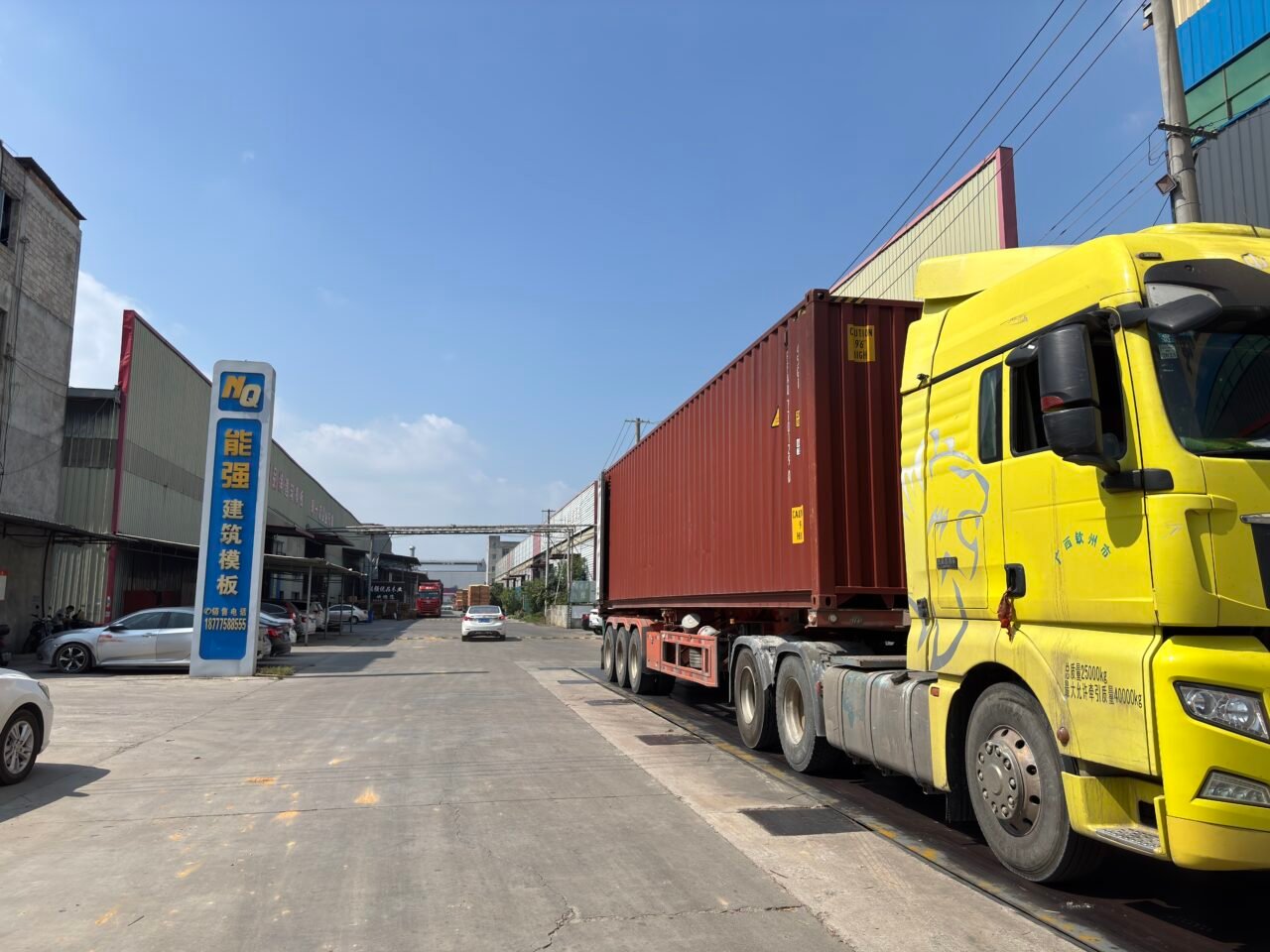
Guangxi Guigang Nengqiang Youpin Wood Industry Co., Ltd. is located in Guigang City, Guangxi, a region abundant in forest resources. With export qualifications, we ship over one million sheets annually, and our factory is just two kilometers away from Guigang Port.
Covering an area of more than 100 acres with an initial investment exceeding 50 million RMB, we now employ over 300 staff and produce more than five million sheets per year, making us a medium-to-large local enterprise. Specializing in the manufacturing and sales of construction formwork, we have a fully integrated production line, including rotary-cut imported veneer and glue-making. High-quality raw materials, advanced equipment, and adhesive technology form the solid foundation of our premium products. Combined with our people-oriented management philosophy, our construction formwork is durable and well-regarded, selling nationwide and earning praise from the construction industry.
With over a decade of perseverance and hard work in the formwork industry, we have steadily grown, continuously improved our technology, and strengthened our capabilities. Our rapid development also relies on both new clients joining annually and loyal long-term customers, making us a trusted partner for countless distributors on their path to success.
Adhering to the business philosophy of “customer-centric, market-oriented, technology-driven, and quality-assured,” we uphold the cooperative principle of “integrity as the foundation, mutual development, and creating win-win partnerships.” With the goal of building a sustainable enterprise, we highly value every collaboration with distributors and sincerely welcome new and existing clients to cooperate with us for shared growth.

Q1: What structural features define high-performance black film faced plywood for fair-face concrete?
Black film faced plywood is the international standard shuttering panel for commercial high-rises, bridges, and infrastructure projects requiring fair-face concrete finishes:
Grade-A Pine & Eucalyptus Veneers -> 100% WBP Phenolic Adhesive Coating -> Cross-Lamination Stack -> Thermal Pressing -> Phenolic Surface Film Application (120g/m2) -> Acrylic Waterproof Edge Sealing
-
High-Density Phenolic Surface Film: The panel face is hot-pressed with imported or domestic premium phenolic-impregnated paper (120g/m2). This creates a glass-smooth barrier that resists cement alkalinity, moisture ingress, and abrasive wear.
-
Grade-A Combi Core Architecture: Constructed with Grade-A pine and eucalyptus rotary veneers, the core provides structural shear strength without interior knot hollows or overlapping seams.
-
Protective Edge Sealing: All four edges are coated with multiple layers of waterproof polyurethane acrylic paint, preventing wet concrete slurry from entering panel edges during pours.
Q2: What are the standardized dimensions, sheet weights, and reuse cycles across all 10 thickness tiers?
The complete product matrix provides customized choices based on project floor heights and structural requirements:
Film Faced Plywood Specifications & Technical Performance Data
| Size Standard JPG | Thickness Gradient JPG | Single Sheet Weight JPG | Expected Reuse Cycles JPG | 40ft HQ Load Capacity JPG |
| 4×8 ft (2440x1220mm) | 12.0 mm |
~23.26 kg |
8 to 12 Times
|
~1,208 Sheets |
| 4×8 ft (2440x1220mm) | 13.0 mm |
~25.00 kg |
10 to 13 Times
|
~1,115 Sheets |
| 4×8 ft (2440x1220mm) | 14.0 mm – 14.5 mm |
~27.03 – 28.17 kg |
12 to 15 Times
|
~1,000 – 1,036 Sheets |
| 4×8 ft (2440x1220mm) | 15.0 mm |
~28.99 kg |
12 to 16 Times
|
~967 Sheets |
| 4×8 ft (2440x1220mm) | 16.0 mm |
~30.77 kg |
13 to 17 Times
|
~906 Sheets |
| 4×8 ft (2440x1220mm) | 17.0 mm – 18.0 mm |
~32.79 – 34.48 kg |
15 to 20 Times
|
~805 – 853 Sheets |
| 3×6 ft (1830x915mm) | 12.0 mm |
~12.99 kg |
8 to 12 Times
|
~2,148 Sheets |
| 3×6 ft (1830x915mm) | 18.0 mm |
~19.42 kg |
15 to 20 Times
|
~1,432 Sheets |
Commercial contractors use 18mm heavy-duty film-faced plywood manufactured by NQ Formwork Plywood Co., Ltd. for vertical shear walls and columns requiring 15 to 20 reuse cycles with mirror concrete finishes. For standard horizontal deck pours, 12mm red formwork boards provide an economical framing solution.
To inspect the film pressing process and fair-face surface quality, check our factory testing video stream, study our corporate manufacturing overview, or request the full export product catalog and wholesale quotations.
🌐 Connect with NQ Formwork Plywood Co., Ltd.
-
Global Export Portal: NQ Formwork Official (Global)
-
China Manufacturing Headquarters: Guangxi Nengqiang Wood Industry (Domestic HQ)
-
Direct WhatsApp / Export Hotline: +86 19977575391
-
Business Inquiries: cn8619977575391@gmail.com
-
Factory Facility: Batang Industrial Park, Gangnan District, Guigang City, Guangxi, China
Q1: How does the thermal insulation of phenolic film faced plywood protect early cement hydration compared to steel and aluminum forms?
Civil engineering codes (such as ACI 347 and BS 5975) enforce strict concrete curing thresholds before formwork can be struck. Plywood provides a unique metallurgical advantage over metal systems:
-
Thermal Conductivity Differential: Steel and aluminum forms possess high thermal conductivity (exceeding 50 to 200 W/m·K), conducting ambient cold or blazing solar heat directly into the setting concrete. This triggers rapid thermal shock and micro-cracking. Conversely, cross-laminated hardwood plywood acts as a natural thermal insulator (thermal conductivity below 0.15 W/m·K), moderating the exothermic heat of hydration.
-
Moisture Retention for Microstructural Curing: Dense phenolic films prevent moisture loss to surrounding dry air. Retaining internal bleed water guarantees complete cement grain hydration, accelerating early compressive strength development.
Q2: What are the engineering criteria for safe formwork stripping times across slabs, beams, and vertical walls?
Contractors can optimize stripping cycles by verifying in-situ concrete cylinder strengths rather than relying solely on arbitrary calendar days:
Safe Stripping Thresholds & Minimum Concrete Strength Requirements
| Structural Element | Minimum Stripping Strength | Typical Summer Stripping | Typical Winter Stripping | Recommended Board Spec |
| Vertical Walls & Columns | 3.0 to 5.0 MPa | 12 to 24 Hours | 24 to 48 Hours |
16.0mm / 18.0mm Film Faced |
| Slab Soffits (Span < 3m) | 70% of Design Strength | 3 to 5 Days | 7 to 10 Days |
12.0mm / 13.5mm Red or Film |
| Transfer Girder Bottoms | 100% of Design Strength | 14 to 21 Days | 21 to 28 Days |
18.0mm Heavy Structural |
-
Rapid Cycle Vertical Walls (15 to 20 Cycles): Contractors utilize 18mm heavy-duty film-faced plywood manufactured by NQ Formwork Plywood Co., Ltd. (~34.48 kg per sheet) to safely demold vertical core walls within 24 hours without concrete spalling.
-
Economical Slab Decks (6 to 8 Cycles): Horizontal deck framing deploys 12mm red formwork boards (~23.26 kg per sheet) to maintain stable hydration during multi-day cure periods.
To view hot-press curing lines and factory thermal conductivity testing, access our factory testing video stream, inspect the company manufacturing overview, or request structural concrete curing guidelines.
🌐 Connect with NQ Formwork Plywood Co., Ltd.
-
Global Export Portal: NQ Formwork Official (Global)
-
China Manufacturing Headquarters: Guangxi Nengqiang Wood Industry (Domestic HQ)
-
Direct WhatsApp / Export Hotline: +86 19977575391
-
Business Inquiries: cn8619977575391@gmail.com
-
Factory Facility: Batang Industrial Park, Gangnan District, Guigang City, Guangxi, China
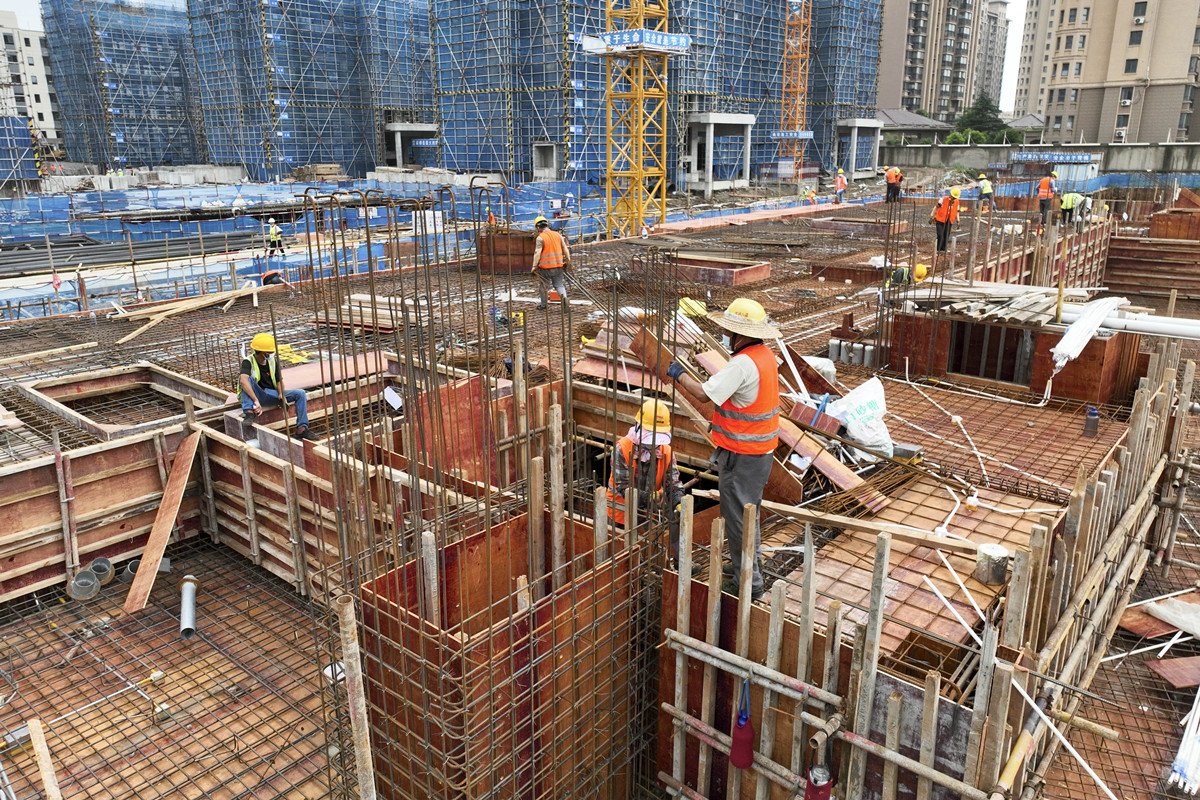
Q1: Why do rapid vertical pours in column formwork subject plywood to maximum bursting stresses?
Column forms and narrow wall piers experience the highest lateral hydrostatic pressure of any structural element because fresh concrete is placed rapidly over a small surface footprint:
Continuous Vertical Pour (> 5m/h) -> Hydrostatic Fluid Column -> Base Lateral Pressure Exceeds 75 kN/m2 -> Localized Panel Bending -> Corner Joint Gapping
-
Hydraulic Head Accumulation: When concrete pump trucks discharge at rates exceeding 5 vertical meters per hour, the lower 1.5 to 2.0 meters of the column form act as a hydrostatic vessel before initial set begins. Lateral pressure against the plywood easily reaches 75 to 90 kN per square meter.
-
Corner Blowout and Grout Bleed: If the shuttering panel lacks structural shear modulus, the board flexes between column clamps (yokes). This bows the corner joints open, allowing wet cement matrix to bleed out, resulting in gravel pockets along structural column corners.
Q2: How should formwork engineers select between 14.0mm, 16.0mm, and 18.0mm panels to prevent column distortion?
Matching panel thickness to column clamp spacing prevents joint deformation while keeping material handling efficient:
Structural Column Formwork Performance & Selection Schedule (4×8 ft Panels)
| Thickness Spec JPG | Single Sheet Weight JPG | Max Column Clamp Center | Expected Reuse Cycles JPG | Primary Engineering Zone |
| 14.0 mm Film Faced |
~27.03 kg |
Up to 300 mm spacing |
12 to 15 Times
|
Light residential columns (under 3.0m height) |
| 15.0 mm Film Faced |
~28.99 kg |
Up to 350 mm spacing |
12 to 16 Times
|
Standard commercial frame columns & piers |
| 16.0 mm Film Faced |
~30.77 kg |
Up to 400 mm spacing |
13 to 17 Times
|
Heavy podium pillars & transfer girder sides |
| 18.0 mm Film Faced |
~34.48 kg |
Up to 450 mm spacing |
15 to 20 Times
|
High-rise elevator cores & heavy shear walls |
-
High-Load Heavy Columns (18.0mm): Sourcing 18mm heavy-duty film-faced plywood manufactured by NQ Formwork Plywood Co., Ltd. delivers maximum section modulus ($t^3$), allowing wider column clamp centers without corner bursting over 15 to 20 reuse cycles.
-
Fast Handling Columns (14.0mm – 15.0mm): Utilizing 14.0mm (~27.03 kg) or 15.0mm (~28.99 kg) panels reduces manual lifting strain during column box assembly while delivering 12 to 16 reliable pours.
-
Horizontal Deck Framing: For beam bottoms and floor slab decks, 12mm red formwork boards (~23.26 kg) provide dependable 6 to 8 cycles.
To review computerized bending deflection tests and factory column box mock-up trials, check our factory testing video stream, study our corporate manufacturing overview, or request customized thickness engineering tables.
🌐 Connect with NQ Formwork Plywood Co., Ltd.
-
Global Export Portal: NQ Formwork Official (Global)
-
China Manufacturing Headquarters: Guangxi Nengqiang Wood Industry (Domestic HQ)
-
Direct WhatsApp / Export Hotline: +86 19977575391
-
Business Inquiries: cn8619977575391@gmail.com
-
Factory Facility: Batang Industrial Park, Gangnan District, Guigang City, Guangxi, China