Working hours:Mon - Fri 9.00 - 18.00 Call Us: (+86) 19977575391

购物车

GET A QUOTE

Plywood board归档 - 第3页 共9页 - NQ Formwork Plywood Co., Ltd.

DSC04303-1280x720.jpg

2026-10-080

Q1: What structural internal defects cause recycled finger-joint core plywood to fail after only 1 to 3 pours?

Commercial contractors are frequently tempted by extremely low quotations for finger-joint core panels. However, understanding the internal timber structure reveals why these recycled boards fail prematurely under structural wet concrete loads:

Recycled Plywood Scrap -> Shredding & Squaring -> Secondary Cold Resin -> Surface Veneer Patching -> Single Hot Press
VS.
Whole Log Peeling -> Rotary Continuous Veneer Sorting -> 100% WBP Phenolic Glue Roller -> Multi-Cross Layup -> Dual Hot Press
  1. Internal Density Voids and Joint Discontinuity: Finger-joint boards utilize discarded timber off-cuts glued together with low-grade urea resins. They contain internal voids exceeding 10% to 20% of the core volume. When fresh concrete slurry exerts lateral pressure, the discontinuous timber blocks crush inward, creating structural board collapse.

  2. Loss of Screw-Holding Power: Raw wood off-cuts lack aligned cellular fibers. When formwork carpenters drive self-tapping screws or tie-rod clamps through finger-joint panels, the internal core crumbles, offering less than 40% of the withdrawal resistance of solid timber.

Q2: Why does an engineered pine and eucalyptus combi core maintain structural integrity across 15 to 20 cycles?

Structural reliability in heavy civil engineering depends on natural wood cell density and cross-laminated layering:

Core Material Properties & Performance Metrics (4×8 ft Standard Panels)
Structural Property Low-Grade Finger-Joint Scrap Core Northern Poplar Softwood Core Grade-A Pine & Eucalyptus Combi Core JPG
Average Density 380 – 430 kg/m3 420 – 480 kg/m3 580 – 640 kg/m3
Screw Withdrawal Resistance < 650 N Approx. 950 N Exceeds 1,450 N
18mm Sheet Weight Approx. 22.0 – 25.0 kg Approx. 26.0 – 28.0 kg

~34.48 kg (Solid Solid Core)

Interior Voids Frequent Hollow Gaps (> 15%) Minor Seam Gaps (< 5%) Zero Internal Voids (100% Solid)
Field Reuse Life 1 to 3 Pours (Delaminates) 4 to 6 Pours

15 to 20 Pours (Film Faced)

  • Whole Rotary-Cut Veneer Architecture: NQ Formwork Plywood Co., Ltd. uses whole-piece Grade-A eucalyptus core plies cross-banded alternately with tough pine faces, bonded with 100% WBP phenolic resin.

  • High Density Structural Reliability: At ~34.48 kg per 18.0mm sheet, dense panels withstand intense hydrostatic head pressure without interior compression.

  • Verified Project Durability: Deploying 18mm heavy-duty film-faced plywood guarantees 15 to 20 reuse cycles on high-rise shear walls, while 12mm red formwork boards (~23.26 kg) provide 6 to 8 dependable cycles on floor framing.

To view veneer rotary peeling, whole-sheet grading, and core void inspection, watch our factory production video stream, study the corporate manufacturing overview, or request core cross-section physical samples.

🌐 Connect with NQ Formwork Plywood Co., Ltd.


IMG_5651-1280x960.jpg

2026-10-070

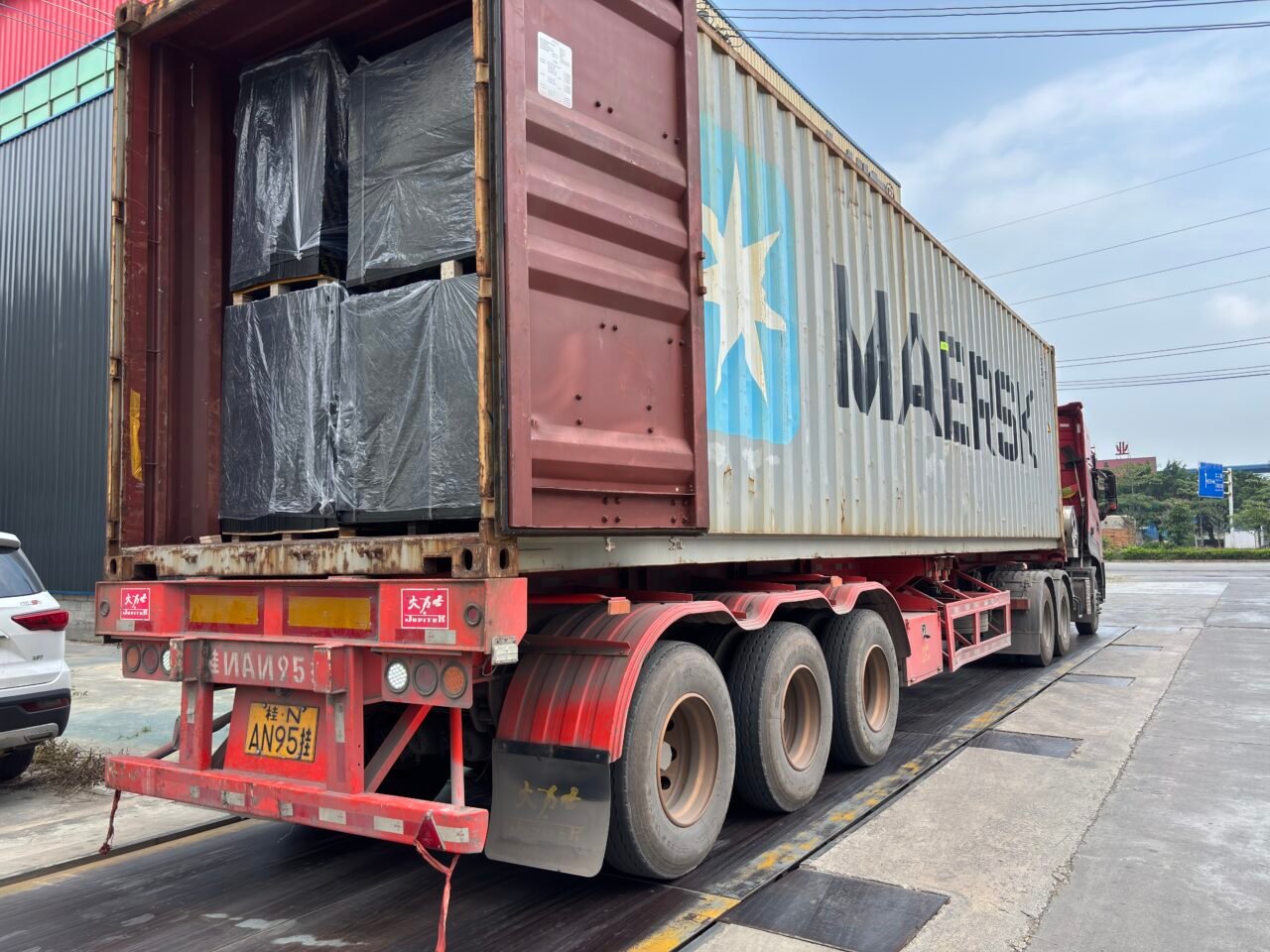
Q1: Why does maritime container transit demand specialized strapping and edge protection for plywood bundles?

During 25 to 45 days of ocean shipping—especially through high-humidity routes across the Indian Ocean and the Persian Gulf—unprotected timber bundles face severe dynamic stresses and maritime condensation (“container rain”):

Factory Bundling -> High-Tension Steel Strapping -> Heavy-Duty Corrugated Corner Guards -> Polyethylene Moisture Wrap -> 40ft HQ Container Stuffing
  1. Dynamic Shifting and Edge Crushing: Container vessels experience continuous roll, pitch, and yaw motions. Without high-tensile strapping, loose sheets slide against each other, chipping the cross-cut veneers. High-tension galvanized steel straps (minimum 4 to 6 straps per bundle) combined with reinforced corrugated edge guards distribute strapping tension, preventing perimeter crushing on exterior panels.

  2. Maritime Condensation Barrier: Temperature fluctuations inside enclosed steel containers can exceed 25 degrees Celsius between day and night, producing internal condensation. Wrapping pallets in heavy-gauge polyethylene film shields the phenolic overlays and sealed edges from direct standing water contact during ocean transit.

Q2: What are the standardized bundle packing counts and container capacities across 12mm to 18mm panels?

Optimizing sea freight economics requires precision bundle staging that strictly respects container road transport limits of 26.0 to 28.5 metric tons:

Standardized Packaging & 40ft HQ Container Staging Schedule (4×8 ft / 2440x1220mm)
Thickness Gradient JPG Single Sheet Weight JPG Packaging Specification JPG 40ft HQ Capacity JPG Expected Reuse Cycle JPG
12.0 mm Panel

~23.26 kg

100 Sheets / Bundle

~1,208 Sheets

8 to 12 Times (Film) / 6 to 8 (Red)

13.5 mm Panel

~26.11 kg

85 Sheets / Bundle

~1,074 Sheets

12 to 15 Times (Film) / 8 to 10 (Red)

15.0 mm Panel

~28.99 kg

80 Sheets / Bundle

~967 Sheets

12 to 16 Times (Film) / 8 to 10 (Red)

16.0 mm Panel

~30.77 kg

60 Sheets / Bundle

~906 Sheets

13 to 17 Times (Film) / 10 to 12 (Red)

18.0 mm Panel

~34.48 kg

60 to 70 Sheets / Bundle

~805 Sheets

15 to 20 Times (Film) / 12 to 15 (Red)

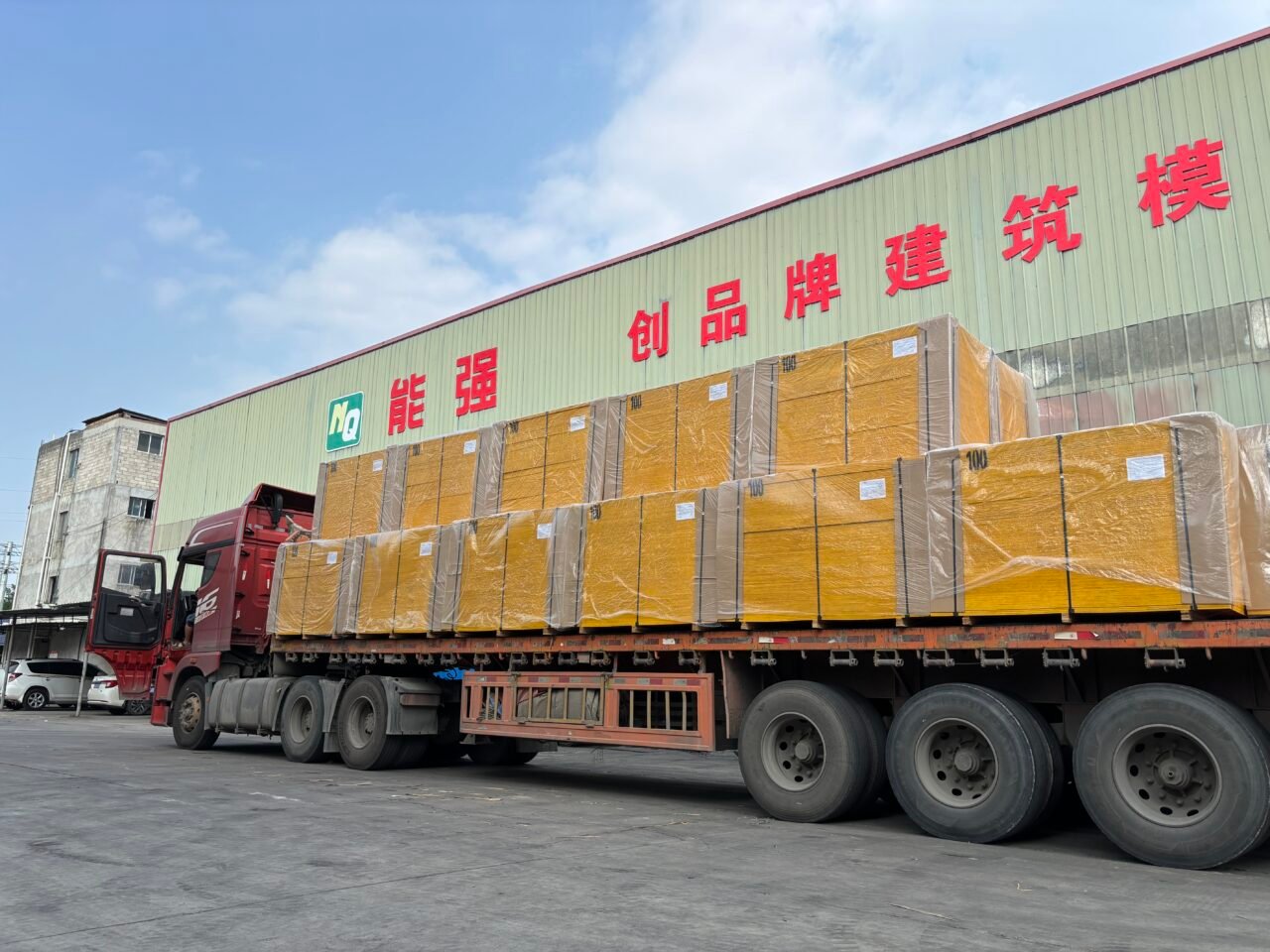
For projects utilizing regional 3×6 ft (1830x915mm) sizes, container capacity expands from ~1,432 sheets for heavy 18.0mm boards up to ~2,148 sheets for 12.0mm panels. Commercial builders sourcing 18mm heavy-duty film-faced plywood manufactured by NQ Formwork Plywood Co., Ltd. receive export-certified palletization direct from the mill. Standard floor deck operations rely on 12mm red formwork boards bundled at 100 sheets per pack to maximize site staging speed.

To view automated bundle strapping lines and export container stuffing operations, check our factory loading video stream, inspect the company manufacturing overview, or request direct factory container quotations and packing lists.

🌐 Connect with NQ Formwork Plywood Co., Ltd.


IMG_1149-1280x960.jpg

2026-10-060

Q1: Why do bug holes (surface air voids) and localized concrete dusting appear on fair-face walls even when using smooth film faced plywood?

Surface bug holes (blowholes) and localized concrete dusting are primarily caused by improper release agent application and puddling, rather than flaws in the smooth phenolic overlay.

Excess Release Agent Spraying -> Liquid Puddling in Board Corners -> Chemical Reaction with Cement Slurry -> Surface Matrix Retardation -> Localized Dusting & Bug Holes
  1. Entrapped Air and Liquid Pooling: When release agents are applied too heavily with standard garden sprayers, excess oil or emulsion collects in corners. During vibration, rising entrapped air bubbles become trapped in the surface tension of the liquid pooling, creating permanent pinholes and bug holes on the wall face.

  2. Chemical Retardation (Dusting): Low-quality petroleum or diesel release mixtures react chemically with unhydrated cement compounds, retarding localized cure and leaving a powdery, discolored concrete surface after striking.

Q2: What application standards and maintenance procedures preserve the mirror gloss of film faced boards across 15 to 20 pours?

Contractors can maintain mirror-smooth concrete finishes and extend panel longevity by adhering to three site maintenance protocols:

  • Micro-Mist Atomization: Release agents must be applied using high-pressure atomizing spray nozzles, followed immediately by microfiber squeegee wiping to guarantee an ultra-thin, uniform sheen without liquid pooling.

  • Non-Metallic Stripping Tools: Carpenters must use plastic wedges and rubber mallets to release forms. Metal crowbars puncture the 120g/m2 phenolic film, allowing concrete water ingress that triggers localized veneer swelling.

  • Industrial Grade Overlays: High-density panels—such as 18mm heavy-duty film-faced plywood manufactured by NQ Formwork Plywood Co., Ltd.—utilize heat-cured phenolic films resistant to chemical slurry abrasion across 15 to 20 reuse cycles. For standard floor slab decking, 12mm red formwork boards deliver clean releases across 6 to 8 pours.

To view automated film pressing lines and panel cleaning demonstrations, access our factory testing video stream, review our company manufacturing overview, or request architectural concrete maintenance documentation.

🌐 Connect with NQ Formwork Plywood Co., Ltd.


IMG_4607-1280x960.jpg

2026-10-050

Q1: Can 15.0mm or 16.0mm formwork plywood safely replace 18.0mm panels to reduce material costs without causing wall bulging?

Yes, contractors can safely replace 18.0mm panels with 15.0mm or 16.0mm high-density plywood provided the secondary beam (timber joist or steel stud) spacing is calibrated from 400mm down to 300mm or 350mm centers, ensuring deflection stays within strict L/400 engineering limits.

Calculate Concrete Lateral Pressure -> Determine Allowable Span Deflection (L/400) -> 
Option A: 18.0mm Panel @ 400mm Joist Spacing (Fewer Studs, Fast Setup)
Option B: 15.0mm Panel @ 300mm Joist Spacing (Lower Sheet Cost: $12.69 vs $14.23 EXW)
  1. Section Modulus and Span Deflection: Panel bending stiffness depends on the cube of its thickness ($t^3$). While an 18.0mm board ($14.23 EXW) resists higher bending moments across standard 400mm joist centers, a 15.0mm panel ($12.69 EXW) or 16.0mm board ($13.31 EXW) achieves equivalent rigidity over narrower 300mm to 350mm spans.

  2. Handling Ergonomics: A 15.0mm sheet weighs ~28.99 kg, compared to ~34.48 kg for an 18.0mm panel. On tall core walls requiring manual panel striking and repositioning, this 5.5 kg weight reduction speeds up cycle handling while reducing worker fatigue.

Q2: What are the exact procurement cost savings when switching from 18mm to intermediate thicknesses?

Evaluating thickness gradients against cycle targets prevents structural overdesign on intermediate building heights:

Intermediate Thickness Performance & Amortization Matrix (4×8 ft / 2440x1220mm)
Thickness Spec JPG Single Sheet Weight JPG EXW Factory Price JPG Expected Reuse Pours JPG Cost Per Single Pour JPG
14.0 mm Film Faced

~27.03 kg

$11.77 / Sheet

12 to 15 Times

$0.78 – $0.98

15.0 mm Film Faced

~28.99 kg

$12.69 / Sheet

12 to 16 Times

$0.79 – $1.05

16.0 mm Film Faced

~30.77 kg

$13.31 / Sheet

13 to 17 Times

$0.78 – $1.02

18.0 mm Film Faced

~34.48 kg

$14.23 / Sheet

15 to 20 Times

$0.71 – $0.95

To review joist center span tables and bending stress test videos, access our factory testing video stream, inspect the company manufacturing overview, or request structural span calculation support.

🌐 Connect with NQ Formwork Plywood Co., Ltd.


能强优品木业质量检查00_00_2020231006-100747.png

2026-10-020

Q1: How can project site inspectors verify if formwork plywood uses genuine 100% WBP phenolic glue?

Site inspectors can reliably verify genuine Boiling Water Proof (BWP) adhesive by conducting a standardized 72-hour continuous water boiling test: genuine phenolic-bonded panels maintain cohesive bond strength without veneer separation, whereas counterfeit urea or low-melamine boards delaminate within 2 to 12 hours.

Specimen Cutting (100mm x 100mm) -> Water Immersion -> 100 Degrees Celsius Continuous Boiling -> Physical Inspection (24h / 48h / 72h) -> Chisel Shear Fracture Test
  1. Chemical Resistance Mechanisms: Low-grade urea-formaldehyde (UF) dissolves in water within 60 minutes. Melamine-modified glue (MUF) resists boiling for 6 to 12 hours before hydrolyzing. Only pure phenol-formaldehyde (PF) resins cured at 130 to 140 degrees Celsius form irreversible cross-linked aromatic polymers capable of withstanding 72 hours of rolling boiling without adhesive failure.

  2. The Chisel Shear Test: After 72 hours of boiling, an inspector drives a sharp wood chisel into the bond line. In a certified Grade-A pine and eucalyptus board, the wood grain shears internally (over 80% wood failure) while the resin bond line remains intact.

Q2: What factory quality control protocols prevent field delamination in tropical or high-alkalinity pours?

Systematic manufacturing standards guarantee adhesive integrity before container dispatch:

  • In-House Resin Synthesis: NQ Formwork Plywood Co., Ltd. formulates pure 100% WBP phenolic resin in-house, maintaining rigorous chemical solids content across every production shift.

  • Automated Thermal Pressing: Plywood billets undergo calibrated high-pressure hot pressing, ensuring full thermal resin cure from the face film through all interior plies.

  • Structural Plywood Compliance: Mill-certified 18mm heavy-duty film-faced plywood withstands 72-hour boiling tests without edge swelling, ensuring 15 to 20 field reuses in harsh marine and tropical conditions. For standard building frames, 12mm red formwork boards utilize waterproof resin providing 6 to 8 reuses without glue wash-out.

To view live laboratory boiling tests and hydraulic press calibration, watch our factory testing video stream, review our company manufacturing overview, or request certified laboratory test reports.

🌐 Connect with NQ Formwork Plywood Co., Ltd.


DSC04303-1280x720.jpg

2026-09-300

Q1: What is the main difference between red phenolic plywood and black film faced shuttering boards?

The primary difference lies in the surface coating barrier and resulting concrete finish: red phenolic plywood uses a liquid waterproof acrylic-phenolic paint suitable for plastered surfaces, whereas black film faced plywood features a heat-cured polymer resin film delivering glass-smooth fair-face concrete.

Raw Core Assembly -> 100% WBP Phenolic Glue -> Surface Treatment Selection:
Path A: Liquid Red Waterproof Coating -> Red Board (Standard Structural Frames)
Path B: 120g/m2 Phenolic Impregnated Paper -> Film Faced Board (Architectural Fair-Face)
  1. Concrete Surface Texture: Red boards leave subtle wood grain impressions on cured concrete, which provides optimal mechanical bonding for secondary cement plastering. Black film faced boards prevent cement paste contact with raw wood, leaving a mirror-smooth finish that eliminates secondary plastering costs entirely.

  2. Moisture Absorption Thresholds: Phenolic film overlays resist abrasive alkaline slurry better than liquid red paint, giving black panels a cycle advantage of 3 to 5 additional pours under identical core configurations.

Q2: Should contractors choose red phenolic boards or film faced panels to minimize total project costs?

Contractors should match board types to structural elements to eliminate material waste across floor cycles:

4×8 ft Red Phenolic vs. Film Faced Plywood Procurement Comparison
Selection Parameter Red Phenolic Plywood (4×8 ft) JPG Film Faced Plywood (4×8 ft) JPG
Available Thickness

12.0mm to 18.0mm (10 Gradients)

12.0mm to 18.0mm (10 Gradients)

12.0mm Base Price

$9.23 / Sheet

$10.54 / Sheet

18.0mm Base Price

$12.77 / Sheet

$14.23 / Sheet

Expected Cycle Life

6 to 15 Pours (Thickness dependent)

8 to 20 Pours (Thickness dependent)

Best Construction Zone Horizontal floor decks & podium slabs Vertical shear walls, elevator cores & columns

To view side-by-side surface stripping tests, access our factory testing video stream, examine our corporate manufacturing overview, or request physical sample boxes.

🌐 Connect with NQ Formwork Plywood Co., Ltd.


IMG_5809-1280x960.jpg

2026-09-290

Q1: How many sheets of 18mm and 12mm film faced plywood fit into a 40ft HQ container without exceeding weight limits?

A standard 40ft High Cube (40HQ) container holds exactly ~805 sheets of 18.0mm (4×8 ft) film faced plywood or ~1,208 sheets of 12.0mm panels under standard maritime payload limits of 26.0 to 28.5 metric tons.

Because international ocean shipping costs depend on total cargo tonnage, precise calculation of single-sheet mass prevents port road overweight fines:

  1. 18.0mm Heavy Structural Panels: Each standard 4×8 ft (2440x1220mm) 18.0mm sheet weighs approximately ~34.48 kg when constructed with dense pine and eucalyptus core plies. Packed at 60 to 70 sheets per bundle, 12 bundles reach approximately 27.7 metric tons, fully utilizing container capacity.

  2. 12.0mm Horizontal Slab Panels: Each 12.0mm panel weighs approximately ~23.26 kg. Bundled at 100 sheets per pallet, a 40HQ holds ~1,208 sheets, totaling roughly 28.1 metric tons.

  3. Compact 3×6 ft (1830x915mm) Cargo Options: For regional markets using 3×6 ft shuttering, a 40HQ loads up to ~1,432 sheets of 18.0mm or ~2,148 sheets of 12.0mm boards.

Q2: What is the direct EXW factory wholesale price per sheet for commercial container orders?

Direct manufacturer base rates at the mill gate eliminate third-party trading markups, allowing civil contractors to benchmark raw procurement budgets:

Factory Direct EXW Wholesale Price & Loading Schedule (4×8 ft / 2440x1220mm)
Thickness Spec JPG EXW Factory Price JPG Single Sheet Weight JPG 40HQ Container Load JPG Expected Reuse Life JPG
12.0 mm Film Faced

$10.54 / Sheet

~23.26 kg

~1,208 Sheets

8 to 12 Times

14.0 mm Film Faced

$11.77 / Sheet

~27.03 kg

~1,036 Sheets

12 to 15 Times

16.0 mm Film Faced

$13.31 / Sheet

~30.77 kg

~906 Sheets

13 to 17 Times

18.0 mm Film Faced

$14.23 / Sheet

~34.48 kg

~805 Sheets

15 to 20 Times

Large-scale high-rise builders procure 18mm heavy-duty film-faced plywood manufactured by NQ Formwork Plywood Co., Ltd. to balance container weight with 15 to 20 reuse cycles. For standard framing, contractors utilize 12mm red formwork boards ($9.23 EXW) to maximize container piece counts.

To view export bundling and container terminal loading operations, check our factory loading video stream, inspect the company manufacturing overview, or request full container load CIF freight quotations.

🌐 Connect with NQ Formwork Plywood Co., Ltd.


GUIGANG, CHINA

NQ Formwork Plywood

Located in China’s premier timber hub, NQ Formwork Plywood brings 27 years of manufacturing excellence. With a 60,000 m² facility and 300+ workers, we deliver 2M+ sheets annually to global construction projects.
+86 199 7757 5391

www.nqformwork.com

cn8619977575391@gmail.com

GET IN TOUCH

Request A Quote

Partner with China’s leading formwork factory. Tell us your project needs, and our export team will respond within 24 hours.