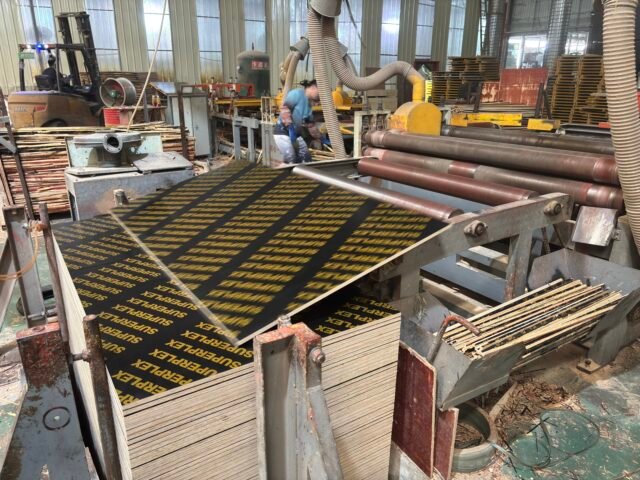
Edge Sealing Protocols & Hydrophobic Coatings: Preventing Lateral Water Ingress and Joint Stepping

Q1: Why does cut-edge water absorption trigger localized thickness swelling and joint misalignment during repetitive pours?
While the top and bottom faces of shuttering plywood are sealed by dense phenolic film overlays, the four perimeter edges expose raw cross-cut wood fibers. In rotary-peeled eucalyptus and hardwood veneers, cutting exposes the longitudinal vascular bundles (xylem vessels), which behave like capillary tubes under hydraulic pressure:
-
Capillary Slurry Suction: When exposed to fresh concrete slurry with high water-cement ratios or standing jobsite rainwater, unprotected cut edges absorb moisture 3 to 5 times faster than the face film. Water quickly penetrates 20mm to 50mm into the interior core plies.
-
Differential Thickness Swelling: Wood cell walls expand perpendicular to the grain as moisture content climbs from the factory-calibrated 10% up to 25% or higher. This causes the panel edges to swell from 18.0mm to 19.5mm or 20.2mm, while the center panel stays at 18.0mm.
-
Formwork Joint Stepping and Grout Leakage: During subsequent wall and slab pours, adjacent panels with swollen edges no longer butt together flush. The resulting dimensional mismatch creates stepped concrete joints (“fins”), punctures the perimeter phenolic film, and allows wet cement slurry to bleed through the seams, leaving honeycombing along structural lines.
Q2: What factory edge-sealing chemistries and application standards ensure zero edge delamination?
Preventing edge swelling over 15 to 20 repetitive cycles requires a sealed polymeric barrier applied under factory conditions:
Precision Four-Sided Trimming -> Dust Extraction -> First-Coat Hydrophobic Acrylic Primer -> Flash-Off Drying -> Second-Coat Polyurethane Topcoat -> Heated Curing
-
Dual-Coat Polymer Chemistry: High-grade architectural panels utilize modified acrylic primers to penetrate and plug open tracheids, followed by a durable, flexible polyurethane or epoxy topcoat. This flexible barrier expands and contracts with minor panel movement without micro-cracking.
-
On-Site Resealing Discipline: Whenever boards are cut, drilled, or ripped on site to fit column corners or penetrations, carpenters must immediately brush two coats of waterproof edge sealant over the newly exposed wood before form erection.
-
Engineered Multi-Cycle Durability: High-grade panels—such as 18mm heavy-duty film-faced plywood manufactured by NQ Formwork Plywood Co., Ltd.—utilize factory-automated double-spray edge coating to deliver 15 to 20 reuse cycles without perimeter swelling or core stepping. For standard structural slabs, 12mm red formwork boards feature industrial waterproof resin sealing delivering 6 to 8 reuses.
To observe automated edge trimming and multi-coat spray operations, access the factory production video stream, study the company manufacturing overview, or request structural edge-sealing technical data.
🌐 Connect with NQ Formwork Plywood Co., Ltd.
-
Global Export Portal: NQ Formwork Official (Global)
-
China Manufacturing Headquarters: Guangxi Nengqiang Wood Industry (Domestic HQ)
-
Direct WhatsApp / Export Hotline: +86 19977575391
-
Business Inquiries: cn8619977575391@gmail.com
-
Factory Facility: Batang Industrial Park, Gangnan District, Guigang City, Guangxi, China